

If you have ever powered through a workday running on four hours of sleep, you already know the fog, the irritability, the third cup of coffee that barely touches it. Sleep deprivation is not rare, the CDC estimates that roughly one in three US adults are not getting enough sleep on a regular basis. What most articles don’t tell you is what actually happens inside your body while you’re running on empty, and, more importantly, exactly how long it takes to recover and what speeds that recovery up.
This guide covers the full picture: what sleep deprivation is, how to spot it early, the four stages it moves through if it’s left unaddressed, and a practical, step-by-step sleep recovery plan you can start tonight.
What Is Sleep Deprivation?
Sleep deprivation happens when you consistently get less sleep than your body needs, or when the sleep you do get is poor quality and doesn’t let you cycle properly through all sleep stages. It can be acute (one bad night before a big deadline) or chronic (weeks or months of insufficient rest), and the two behave very differently in terms of symptoms and recovery time.
Sleep Deprivation vs. Insomnia – What’s the Difference?
These two get confused constantly, but they’re not the same thing. Insomnia is the inability to fall or stay asleep even when you have the opportunity to. Sleep deprivation is simply not getting enough sleep, whether that’s because of insomnia, a demanding schedule, a newborn, or a habit of scrolling until 2 a.m. Insomnia is one possible cause of sleep deprivation, not a synonym for it.
How Much Sleep Do You Actually Need?
Sleep needs shift across your lifespan. According to sleep duration recommendations from the CDC and the National Sleep Foundation, here’s the general guidance by age group:
- Newborns (0–3 months): 14–17 hours
- Infants (4–12 months): 12–16 hours (including naps)
- Toddlers (1–5 years): 10–14 hours (including naps)
- School-age children (6–12 years): 9–12 hours
- Teenagers (13–18 years): 8–10 hours
- Adults (18+ years): 7–9 hours
If you’re consistently getting less than the lower end of your range, your body starts accumulating what sleep researchers call “sleep debt” and that debt has to be repaid, not just ignored.
Signs and Symptoms of Sleep Deprivation
Symptoms build gradually, and most people underestimate how impaired they already are. Early, everyday symptoms include:
- Daytime sleepiness and yawning
- Fatigue that coffee doesn’t fully fix
- Irritability and a short fuse
- Trouble focusing, thinking clearly, or remembering things
- Slower reaction times
- Frequent headaches
- Craving sugar or carbs more than usual
As sleep loss becomes more severe or prolonged, symptoms escalate to something that starts to resemble intoxication:
- Microsleeps, brief, unintentional seconds-long lapses into sleep
- Uncontrollable eye movements
- Slurred or unclear speech
- Drooping eyelids
- Hand tremors
- Visual or tactile hallucinations
- Impaired judgment and impulsive behavior
The 4 Stages of Sleep Deprivation
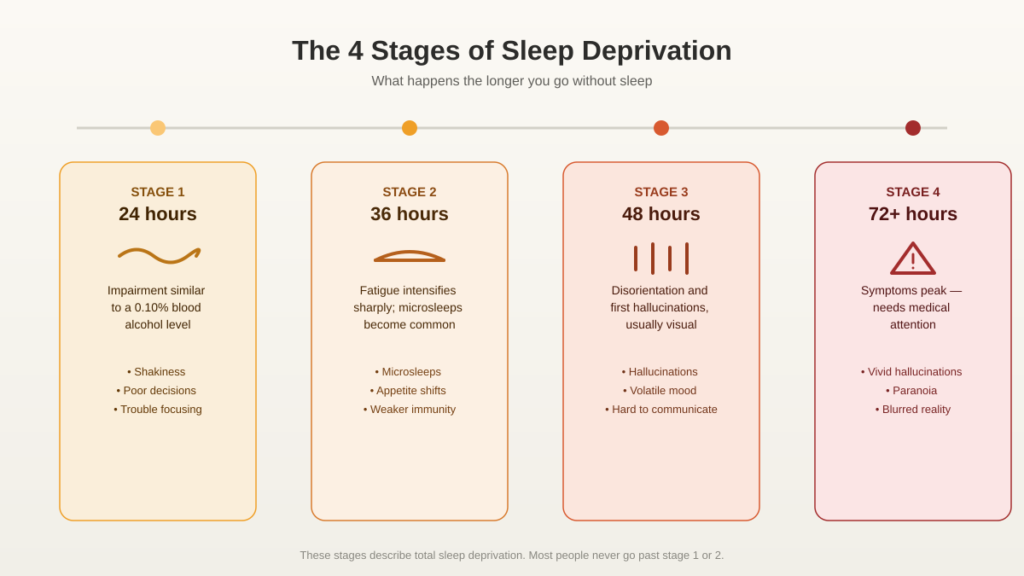
Total sleep deprivation (going without any sleep at all) follows a fairly predictable pattern. Here’s what happens hour by hour:
Stage 1 – 24 hours without sleep
At this point, cognitive and motor impairment is comparable to a blood alcohol level around 0.10% — legally too impaired to drive in most US states. You’ll notice shakiness, poor decision-making, and difficulty concentrating.
Stage 2 – 36 hours without sleep
Fatigue intensifies sharply. Microsleeps become common, appetite and hormone regulation start to shift, and your immune response weakens.
Stage 3 – 48 hours without sleep
This is where “sleep deprivation psychosis” can start to show up, disorientation, irritability that borders on volatile, and the first hallucinations, usually visual.
Stage 4 – 72 hours or more without sleep
Symptoms peak. Hallucinations become more vivid and frequent, paranoia can appear, and the ability to tell what’s real and what isn’t becomes seriously compromised. This level of sleep loss needs medical attention.
To be clear, most people never reach stage 3 or 4. These stages describe total sleep deprivation. Chronic partial sleep deprivation (say, 5 hours a night for months) is far more common and, cumulatively, can be just as damaging to long-term health.
What Causes Sleep Deprivation?
Sleep deprivation usually comes down to lifestyle factors, medical conditions, or a mix of both.
Lifestyle and behavioral causes
- Shift work, especially overnight shifts
- Alcohol use, particularly close to bedtime
- Caffeine or other stimulants late in the day
- Poor sleep hygiene (irregular bedtimes, screen use in bed)
- Chronic stress or an overloaded schedule
- Sleeping in an unfamiliar environment, like during travel
Medical and hormonal causes
- Sleep apnea and other breathing-related sleep disorders
- Chronic pain
- Anxiety, depression, and other mental health conditions
- Restless leg syndrome and parasomnias (night terrors, sleepwalking, sleep paralysis)
- Certain medications, including stimulants and corticosteroids
Hormonal transitions, sleep disturbances are one of the most commonly reported perimenopause symptoms in women and are increasingly recognized as a symptom of andropause in men as testosterone levels decline with age.
How Sleep Deprivation Affects Your Body
Sleep isn’t downtime, it’s when your body repairs itself, consolidates memory, and regulates hormones. Cutting it short has effects across nearly every system:
- Heart and circulatory system: higher risk of high blood pressure and elevated cholesterol over time
- Metabolism: increased risk of insulin resistance and type 2 diabetes
- Immune system: a weaker, slower defense against infections
- Nervous system: heightened pain sensitivity
- Brain function: impaired memory, learning, and, with chronic deprivation, a possible link to long-term neurological decline
- Mental health: a stronger likelihood of anxiety and depressive symptoms, which in turn can make sleep even harder, creating a self-feeding cycle
How Long Does It Take to Recover From Sleep Deprivation?
This is the part most people actually want to know, and it depends heavily on how much sleep debt you’ve built up.
Recovering from one bad night
If it’s a single rough night, one full night of quality sleep, 7 to 9 hours, is usually enough to bring you back to baseline. You might still feel a bit sluggish the next day, but cognitive performance largely rebounds.
Recovering from short-term sleep deprivation (a few days to a week)
Here, expect to need two to four nights of consistent, high-quality sleep. Your body doesn’t just need the hours back, it needs uninterrupted cycles through deep and REM sleep, which is why “sleeping in” for one day rarely fixes a week of poor sleep.
Recovering from chronic sleep deprivation (weeks, months, or longer)
This is where full recovery takes real time, often several weeks of consistently good sleep to restore normal cognitive function, and longer for hormonal and metabolic markers to fully normalize. Research is still ongoing into whether some effects of long-term severe sleep deprivation are fully reversible, which is exactly why catching and correcting it early matters.
A simple rule of thumb sleep researchers use: it typically takes about four days of good sleep to recover from every one day of significant sleep deprivation. It’s not a perfect 1:1 formula, but it explains why a single “recovery weekend” rarely undoes weeks of short sleep.
How to Recover From Sleep Deprivation Fast: A Step-by-Step Sleep Recovery Plan
You can’t shortcut biology entirely, but you can meaningfully speed up how fast you bounce back. Here’s a practical recovery plan:
1. Prioritize your very next night
Don’t try to “push through” and catch up later. Protect your next sleep window like an appointment you can’t miss, 7 to 9 hours, ideally starting within your usual bedtime window.
2. Nap strategically, not randomly
If you’re dragging during the day, a 20–30 minute nap before 3 p.m. can restore alertness without disrupting your ability to fall asleep that night. Longer or later naps tend to backfire.
3. Get morning sunlight
Natural light exposure within the first hour of waking helps reset your circadian rhythm, which makes it easier to fall asleep at a consistent time going forward, a key part of actual sleep recovery, not just symptom relief.
4. Cut caffeine after early afternoon
Caffeine has a half-life of roughly 5–6 hours. That 3 p.m. coffee is still partly active in your system at 9 p.m., quietly undoing the recovery you’re trying to build.
5. Limit alcohol while you’re recovering
Alcohol might help you fall asleep faster, but it fragments sleep and cuts into REM sleep, the exact stage your brain needs most to recover.
6. Keep a consistent wake-up time
It’s tempting to sleep in every day while recovering, but a wildly inconsistent wake time actually slows recovery. Anchor your wake-up time and let your bedtime adjust earlier instead.
7. Rebuild gradually, not all at once
If you are deep in sleep debt, don’t try to force 10+ hours in one night. Add sleep incrementally, an extra 30–60 minutes per night, until you are consistently hitting 7 to 9 hours.
Sleep Debt: Can You Really Catch Up on Sleep?
To a degree, yes, but not the way most people try to. Sleeping 5 hours a night all week and then sleeping 12 hours on Saturday doesn’t erase the debt; it just treats the most obvious symptom (exhaustion) while your metabolic and cognitive systems are still catching up behind the scenes. Consistent, moderate recovery sleep across several nights works far better than one marathon sleep session.
When Should You See a Doctor?
Occasional sleep deprivation is normal and usually self-correcting. It’s worth talking to a healthcare provider if:
- Poor sleep continues even after weeks of good sleep habits
- You suspect sleep apnea, loud snoring, gasping for air, or stopping breathing during sleep
- You’re experiencing hallucinations, severe confusion, or extreme mood changes
Chronic sleep deprivation can raise your risk of heart attack and stroke, so persistent symptoms are worth taking seriously rather than pushing through indefinitely.
The Bottom Line
Sleep deprivation is common, but it isn’t something to just push through indefinitely. The good news is that recovery is very achievable – your body is built to bounce back with the right conditions. Protect your next few nights, keep your wake time consistent, get morning light, and rebuild gradually rather than trying to fix weeks of sleep debt in one long weekend. If sleep problems persist despite doing everything right, that’s your sign to loop in a healthcare provider.
Frequently Asked Questions
How long does it take to recover from sleep deprivation?
One bad night usually resolves after a single full night of quality sleep. Short-term sleep deprivation (a few days to a week) typically takes two to four nights of consistent, good sleep. Chronic sleep deprivation built up over weeks or months can take several weeks of consistent good sleep to fully recover from.
Can you fully recover from years of sleep deprivation?
Most of the day-to-day effects, fatigue, brain fog, mood changes, do improve significantly with consistent, quality sleep over time. Research on very long-term, severe sleep deprivation and its lasting effects on the brain is still ongoing, which is another reason to address chronic sleep loss sooner rather than later.
How can I recover from lack of sleep fast?
Prioritize your next full night of sleep, get morning sunlight to reset your body clock, keep a consistent wake-up time, avoid caffeine in the afternoon, limit alcohol, and use a short 20–30 minute nap if you need to get through the day, not a long one that disrupts your next night.
Can you catch up on sleep debt over the weekend?
Partially, but it’s not a full fix. Sleeping in for one or two days can ease exhaustion, but it doesn’t fully repay a week’s worth of sleep debt. Gradual, consistent extra sleep across several nights is more effective than one long catch-up sleep.
What are the first signs that you’re sleep deprived?
Early signs include daytime sleepiness, fatigue that doesn’t fully lift with caffeine, irritability, trouble concentrating or remembering things, slower reaction times, and more frequent headaches.
What causes poor sleep quality even after a full night in bed?
Poor sleep quality often comes from something disrupting your sleep cycles rather than the total hours, common culprits include sleep apnea, stress and anxiety, alcohol close to bedtime, an inconsistent sleep schedule, screen exposure before bed, and underlying conditions like restless leg syndrome.
How much sleep is considered sleep deprivation?
For most adults, consistently getting less than 7 hours a night qualifies as sleep deprivation, since the recommended range is 7 to 9 hours. The exact threshold varies slightly by individual, age, and health status.
This article is for informational purposes only and is not a substitute for professional medical advice. If you’re experiencing symptoms that concern you, please consult a qualified healthcare provider.